
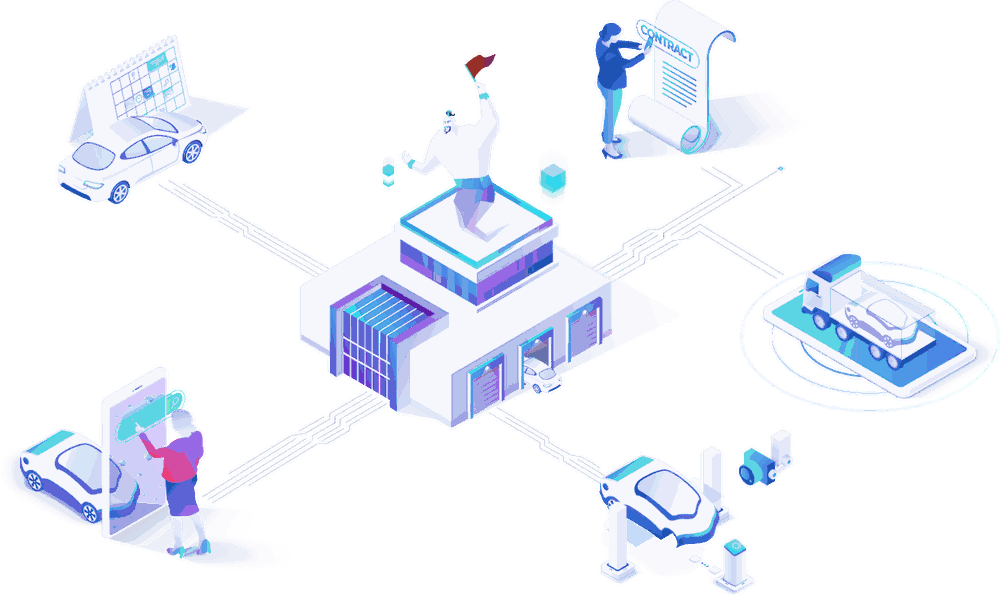
One customer. Six Stages. One continuous Thread.
Every stage pairs automated execution with critical human-in-the-loop checkpoints. PIKAR Genie eliminates redundant data re-entry, turning transitions into seamless automated events.
Discover & consult
A customer scans a QR code at 11 PM, asks about trims and pricing, and gets an instant, exact quote.
DS
Book & Drive
Books a real-time slot in the calendar, gets a vehicle assigned, and chooses between an in-store test drive or home delivery.
TDS
Quote & contract
Generates an official quote directly from the same live price book — and hands off seamlessly to a manager for the final signature.
DNP · gate
Deliver
Vehicle preparation, transport, and delivery are scheduled in sync, with the customer's first service appointment already booked.
DNP
Service, for years
Handles service intake, diagnostics, and repair orders effortlessly — and re-engages customers for deferred maintenance at just the right time.
DWS · gate
The Next Car
Service history builds residual value, transforming into a timely trade-in offer that powers the customer's next vehicle purchase.
Back to 01Stage 06 is not the end of the journey — it is the beginning of the next one. Because the repair history lives on the VIN and the VIN lives next to the customer, the store knows what that car is worth before the customer asks. No single module can see that loop; only an agent sitting above all of them can.
Deploys seamlessly on top of existing systems
EPIKAR does not require replacing your current DMS. Operating through a lightweight middleware layer, initial modules deploy in weeks without disturbing underlying databases or workflows.
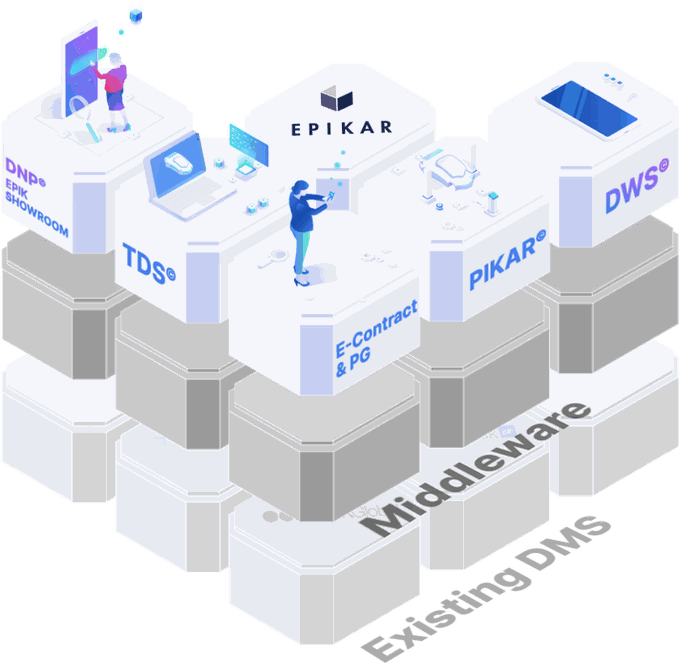
Three-tier architecture: zero data migration required
The bottom layer is the dealer management system you already pay for and your people already know. The middle layer is middleware that reads from it and writes back to it. The top layer is EPIKAR — the blocks you choose, in the order you choose them.
Nothing about that requires a migration, a data freeze or a six-month project plan. It requires one integration, once.
Start in service. Expand across the store.
We don't expect you to hand over your entire showroom to a new platform overnight. Most dealerships start with the service lane: this is where operational bottlenecks are most immediate, and the ROI is most transparent.
EPIKAR recovers revenue you are already losing, proving its value with clear numbers before you expand the rest of your operations.
Technician shortages and advisor turnover leave calls unanswered and service bays empty. EPIKAR ensures every incoming inquiry is handled instantly.
Dealerships already know service AI. EPIKAR sets itself apart by fully executing service workflows rather than simply passing calls to busy staff.
Track real recovered calls, completed recall services, and re-engaged deferred repairs. Backed by tangible metrics, not complex attribution models.
One system. One customer record. Five business lines.
A dealership is five interconnected businesses under one roof — a well-maintained car boosts trade-in value, and an expiring lease opens the door to the next sale. In traditional stores, these opportunities leak between disconnected point tools. EPIKAR connects every department on a single platform so no revenue opportunity slips through the cracks.
Sales & Retail
Greeting, consultation, test drive, quote, contract, delivery. Steps back for human expertise where trust matters most.
Service & parts
Handles call capture, intake triage, repair orders, recall recovery, and automated follow-ups for deferred maintenance.
Used, trade-in & finance
Powers trade-in appraisals using real service history, streamlining disclosures, financing applications, and lease-expiry pipelines.
Service history builds residual value, transforming into compelling trade-in offers. A trade-in drives the next new vehicle purchase, powering financing, and leading seamlessly into the next service appointment. EPIKAR unifies customer and VIN records to keep this revenue flywheel turning.
The next evolution of auto retail
Why legacy point tools fall short — and why enterprise operations require a unified operating system
| Point tools | EPIKAR |
|---|---|
| Manages isolated channels (web leads or incoming phone calls) | Executes unified operations across all 5 core business lines |
| Routes unresolved leads to already overwhelmed dealership staff | Automates routine tasks and hands off fully decision-ready buyers |
| Fragments customer history across disconnected vendor silos | Unifies data on a single Customer 360 & VIN master ledger |
| Transports sensitive customer PII to external vendor cloud servers | Runs on-premise; raw customer PII never leaves your facility |
| Tested primarily in feature-specific or limited-scope pilots | Proven in live flagship dealership operations with full P&L accountability |
Straight answers.
What is EPIKAR?
EPIKAR is an AI-native enterprise platform for automotive dealerships and OEMs. Founded in 2016, we validated our architecture by running a high-volume flagship dealership in Seoul with full P&L accountability — now licensing and deploying the platform across major US dealer groups.
Where should a dealership start?
In the service lane (DWS), in nearly every case. Service represents the highest operational friction and the clearest, most measurable ROI. Once proven within your facility, expanding to sales, inventory, and finance leverages the same underlying architecture.
Do we need to replace our current DMS or CRM?
No, EPIKAR operates directly on top of your existing infrastructure. Through a lightweight middleware integration layer, EPIKAR connects seamlessly with your current DMS and CRM without requiring high-risk database migrations or operational downtime.
Where is customer data stored and processed?
Data stays completely inside your dealership. AI inference runs on dedicated on-premises hardware within your facility. Raw customer databases and personally identifiable information (PII) never leave your local environment.
Does EPIKAR support OEM-specific data models?
Yes. EPIKAR features an OEM-dedicated data pipeline. Models are trained exclusively on your specific brand architecture, official vehicle specifications, repair manuals, and price books — never on generic web data.
How long does full implementation take?
Deployment takes weeks, not quarters. Designed for modular setup, initial capabilities go live rapidly with minimal IT overhead, allowing dealer teams to manage and scale operations independently.